Checked against E. T. C. Werner’s Myths and Legends of China (Project Gutenberg), Britannica and Fox-Davies · Published 31 October 2026
Spirits of the waters
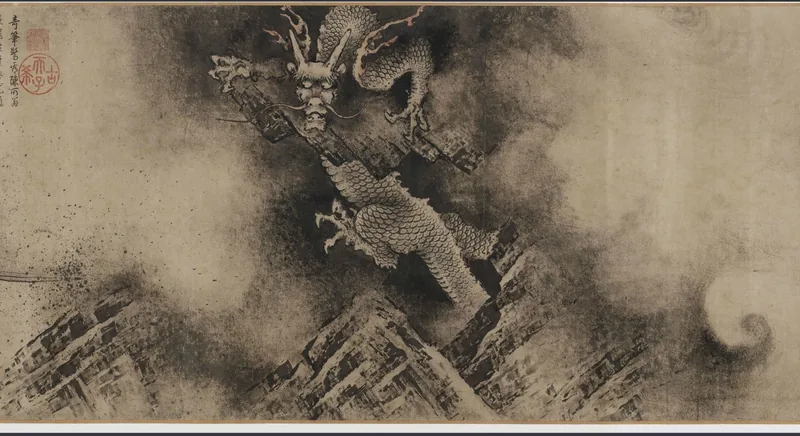
Tradition In Chinese myth, Werner writes, ‘the dragons are spirits of the waters’. E. T. C. Werner, Myths and Legends of China, Project Gutenberg ↗
Tradition The Chinese dragon is not a power for evil but a kindly being that brings rain. E. T. C. Werner, Myths and Legends of China, Project Gutenberg ↗
History Britannica says the long was originally a rain god. Rain rituals as early as the 6th century BCE used a dragon image moved by a procession of dancers. Britannica (Scholars): long (Chinese mythology) ↗
Tradition In Chinese belief, every cloud with a curious shape is a dragon. E. T. C. Werner, Myths and Legends of China, Project Gutenberg ↗
Tradition In spring the dragon rises to the skies; in autumn it buries itself in the watery depths. E. T. C. Werner, Myths and Legends of China, Project Gutenberg ↗
Four kinds of dragon
Tradition Werner lists four kinds: the celestial dragon, which guards the mansions of the gods; the divine dragon, which brings wind and rain; the earth-dragon, which marks out rivers; and the dragon of hidden treasures. E. T. C. Werner, Myths and Legends of China, Project Gutenberg ↗
History Ancient Chinese thinkers named four types of dragon: the Celestial Dragon (Tianlong), the Dragon of Hidden Treasure (Fuzanglong), the Earth Dragon (Dilong), who controls the waterways, and the Spiritual Dragon (Shenlong), who controls the rain and winds. Britannica (Scholars): long (Chinese mythology) ↗
Werner and Britannica give the same four kinds in slightly different English: Werner’s ‘divine dragon’ and Britannica’s Spiritual Dragon (Shenlong) both bring wind and rain.
What a dragon looks like
Tradition The dragon is said to have nine ‘resemblances’: its horns are like a deer’s, its scales like a carp’s, its claws like an eagle’s and its ears like an ox’s, among others. E. T. C. Werner, Myths and Legends of China, Project Gutenberg ↗
Tradition Werner calls the dragon the chief of the 360 scaly creatures. E. T. C. Werner, Myths and Legends of China, Project Gutenberg ↗
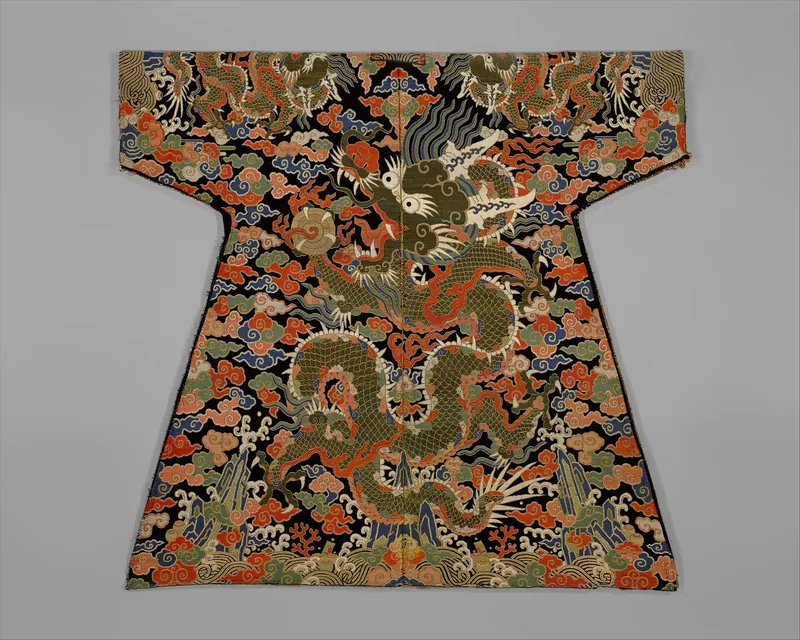
Tradition The imperial dragon has five claws on each foot; other dragons only four. E. T. C. Werner, Myths and Legends of China, Project Gutenberg ↗
Tradition A pearl is often shown in front of the dragon. Werner says it represents the sun. E. T. C. Werner, Myths and Legends of China, Project Gutenberg ↗
Dragon kings
Tradition The Sea-dragon Kings live in gorgeous palaces deep under the sea and feed on pearls and opals. There are five of them. E. T. C. Werner, Myths and Legends of China, Project Gutenberg ↗
History In popular belief they became the Dragon Kings (Longwang), gods who lived in the four oceans, brought rain and protected sailors. Britannica (Scholars): long (Chinese mythology) ↗
The emperor’s emblem
History The long was considered the king of animals, and Chinese emperors took its image as a sacred symbol of their power. Britannica (Scholars): long (Chinese mythology) ↗
History The Chinese dragon stands for yang, ‘the principle of heaven’, says Britannica. It was the emblem of the imperial family and was on the Chinese flag until the republic was founded in 1911. Britannica (Scholars): dragon ↗
History The Chinese dragon, when it appears in British heraldry (for example as a supporter of Sir Robert Hart’s arms), follows the Chinese model and has no wings. A. C. Fox-Davies, A Complete Guide to Heraldry, Project Gutenberg ↗
Boats, years and Japan
Tradition The Dragon-boat Festival falls on the fifth day of the fifth moon. Long, narrow boats shaped like dragons race, and one aim was to bring enough rain. E. T. C. Werner, Myths and Legends of China, Project Gutenberg ↗
History Chinese years are named after 12 animals: 11 real ones and the dragon. Britannica (Students): dragon ↗
History In Japan the dragon (ryū or tatsu) could change its size at will, even becoming invisible. Chinese and Japanese dragons are usually wingless. Britannica (Scholars): dragon ↗
Follow the thread
E. T. C. Werner, Myths and Legends of China, Project Gutenberg ↗
Britannica (Scholars): long (Chinese mythology) ↗
Britannica (Scholars): dragon ↗
A. C. Fox-Davies, A Complete Guide to Heraldry, Project Gutenberg ↗
Britannica (Students): dragon ↗
Retellings are in our own words. Every sentence above carries a label (History, Literature or Tradition) and a link to the source it was checked against. A legend is not a historical record.
Source method & more reading ↗