THE DRAGON ATLAS
Follow a dragon
to its landscape.
Select a numbered place or use the list. Markers are approximate, illustrative and not directions.
Thirteen places, thirteen threads
Choose a place to see its dragon link.
Use official site information for access and opening times. A legend never gives permission to enter private land.
The atlas, in words, with sources
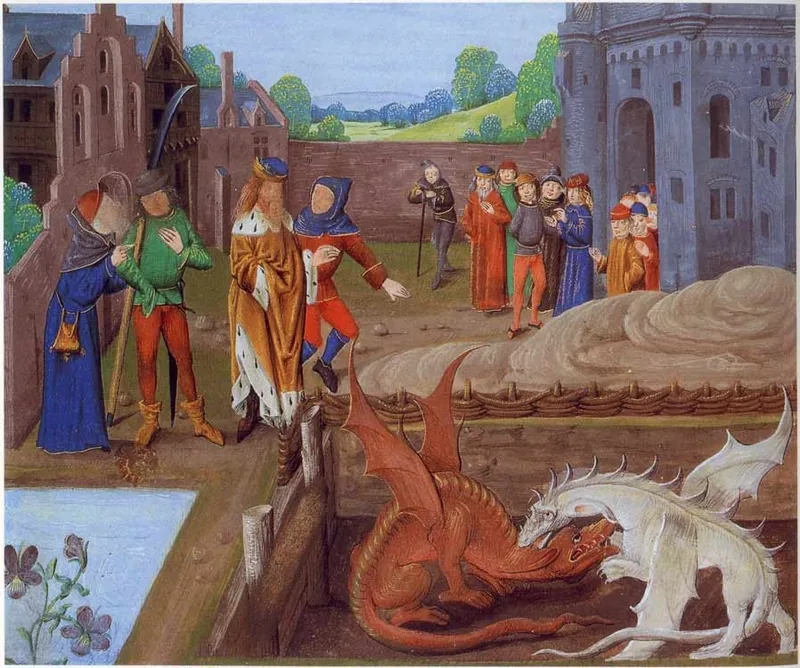
Dinas Emrys · Vortigern’s hill
Literature In Giles’s notes, the hill where Vortigern tried to build is ‘supposed to be Dinas Emrys, or the fortress of Ambrosius’, in the mountains of Snowdon. Nennius, History of the Britons, trans. J. A. Giles, Project Gutenberg ↗
Literature Inside the tent slept two serpents, one white and one red. They woke and fought. Three times the white one drove the red one back, but at last the red one grew strong and chased the white one out of the tent and across the pool. Nennius, History of the Britons, trans. J. A. Giles, Project Gutenberg ↗
History Visit Wales reports that an excavation of Dinas Emrys in 1945 showed evidence of a lake and a fortress dating back to Vortigern’s time. Visit Wales: The legend of the Welsh dragon ↗
Dragon Hill, Uffington · Where the dragon fell, says tradition
Tradition At Uffington the bare white patch on top of Dragon Hill is said to be where the dragon fell dead, its blood so poisonous that grass has never grown there. National Trust: History at White Horse Hill ↗
History Dragon Hill is about 10 metres high: a natural outcrop of the downs, shaped by melting ice in the Ice Age. National Trust: History at White Horse Hill ↗
History English Heritage says local legend links the White Horse with St George and the Dragon, hence the name of nearby Dragon Hill. English Heritage: History of Uffington Castle, White Horse and Dragon Hill ↗
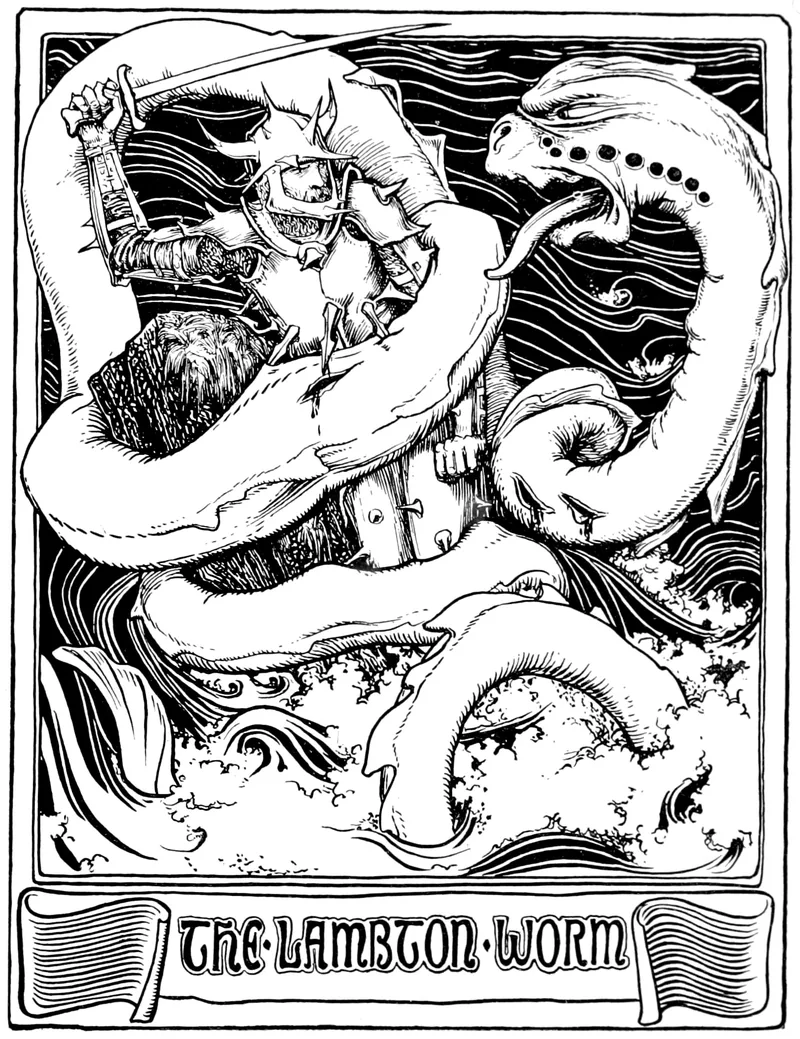
Read the linked notebook ↗Worm Hill, Lambton · The Lambton Worm
History Worm Hill is oval, on the north side of the River Wear, about a mile and a half from old Lambton Hall. William Henderson, Notes on the Folk-Lore of the Northern Counties of England and the Borders (1879), chapter 8, Wikisource ↗
Literature One Sunday he hooked an ugly worm and flung it into a well close by, still called the Worm Well. William Henderson, Notes on the Folk-Lore of the Northern Counties of England and the Borders (1879), chapter 8, Wikisource ↗
Tradition The Lambton curse said that for nine generations no lord of Lambton would die in his bed. William Henderson, Notes on the Folk-Lore of the Northern Counties of England and the Borders (1879), chapter 8, Wikisource ↗
Sockburn · The falchion
Tradition At Sockburn on the Tees, each new Bishop of Durham was met at Croft Bridge or in the river and handed the falchion (a curved sword) with which ‘the champion Conyers slew the worm’. William Henderson, Notes on the Folk-Lore of the Northern Counties of England and the Borders (1879), chapter 8, Wikisource ↗
Read the linked notebook ↗Bamburgh and Spindleston · The Laidly Worm
Literature A king left his daughter, the Lady Margaret, in charge of Bamborough Castle while he went to fetch a new queen. William Henderson, Notes on the Folk-Lore of the Northern Counties of England and the Borders (1879), chapter 8, Wikisource ↗
Literature The worm lived at Spindleston Heugh. It was so poisonous that for seven long miles around nothing green would grow. William Henderson, Notes on the Folk-Lore of the Northern Counties of England and the Borders (1879), chapter 8, Wikisource ↗
Literature He landed on the sands of Budle. The worm asked him to lay down his sword and give her ‘kisses three’. He did, and out stepped a lady: his sister. William Henderson, Notes on the Folk-Lore of the Northern Counties of England and the Borders (1879), chapter 8, Wikisource ↗
Read the linked notebook ↗Linton · The Worm of Linton
Tradition The Worm of Linton, in the Scottish Borders, had its den in a hollow still called the ‘Worm’s Hole’. The laird of Lariston killed it by thrusting a peat dipped in scalding pitch, fixed on his lance, down its throat. William Henderson, Notes on the Folk-Lore of the Northern Counties of England and the Borders (1879), chapter 8, Wikisource ↗
Tradition The dying Linton worm was said to have twisted so hard that the sides of Wormington Hill still show spiral marks. William Henderson, Notes on the Folk-Lore of the Northern Counties of England and the Borders (1879), chapter 8, Wikisource ↗
Tradition The Somerville family claimed the deed for John Somerville, who received Linton in 1174, saying William the Lion gave it as a reward. They bear a dragon in their crest. William Henderson, Notes on the Folk-Lore of the Northern Counties of England and the Borders (1879), chapter 8, Wikisource ↗
Read the linked notebook ↗Mordiford · A fight in the river Lug
Tradition At Mordiford in Herefordshire the fight was said to have happened in the river Lug. A painting in the church showed the dragon as a winged serpent about twelve feet long. William Henderson, Notes on the Folk-Lore of the Northern Counties of England and the Borders (1879), chapter 8, Wikisource ↗
Read the linked notebook ↗Deerhurst · Milk and an axe
Tradition At Deerhurst, near Tewkesbury, a man named John Smith put milk near a serpent’s lair. It drank and lay down to sleep, and he cut off its head with an axe. William Henderson, Notes on the Folk-Lore of the Northern Counties of England and the Borders (1879), chapter 8, Wikisource ↗
Read the linked notebook ↗St Leonard’s Forest · Lilies and nightingales
Tradition In St Leonard’s Forest in Sussex, the saint was said to have fought a dragon, and beds of lilies of the valley spring up wherever his blood fell. William Henderson, Notes on the Folk-Lore of the Northern Counties of England and the Borders (1879), chapter 8, Wikisource ↗
Tradition The same tale says the singing nightingales disturbed the saint’s prayers, so he told them to leave and they never came back. William Henderson, Notes on the Folk-Lore of the Northern Counties of England and the Borders (1879), chapter 8, Wikisource ↗
Tradition An account written in 1614 reported a serpent ‘oft-times seen’ at Faygate, within a mile of Horsham, nine feet long. William Henderson, Notes on the Folk-Lore of the Northern Counties of England and the Borders (1879), chapter 8, Wikisource ↗
Read the linked notebook ↗St Osyth · A dragon of marvellous bigness
Tradition At St Osyth in Essex, in 1170, a dragon ‘of marvellous bigness’ was said to set fire to houses simply by moving. William Henderson, Notes on the Folk-Lore of the Northern Counties of England and the Borders (1879), chapter 8, Wikisource ↗
Read the linked notebook ↗Chipping Norton · A two-headed serpent
Tradition Near Chipping Norton in Oxfordshire, in 1349, a serpent with two heads and bat-like wings was reported. William Henderson, Notes on the Folk-Lore of the Northern Counties of England and the Borders (1879), chapter 8, Wikisource ↗
Read the linked notebook ↗St Paul’s Cathedral, London · Henry Tudor’s dragon banner
History Henry Tudor put a red dragon on a white and green background, the Tudor colours, and presented it at St Paul’s Cathedral after his victory at Bosworth in 1485. Visit Wales: The legend of the Welsh dragon ↗
Read the linked notebook ↗Isle of Man · The Sigurd crosses
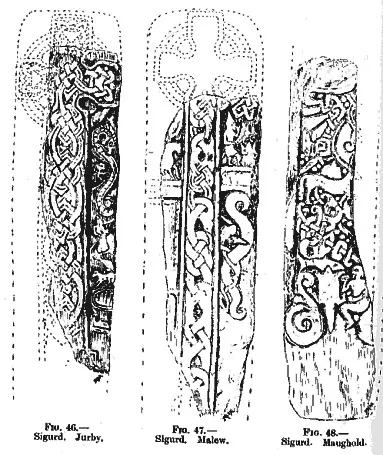
History The Andreas cross is one of four Sigurd crosses found on the Isle of Man; the others are at Jurby, Malew and Maughold. Isle of Man Guide: Sigurd’s Cross (no. 121), Kirk Andreas ↗
History Sigurd’s Cross at Kirk Andreas (no. 121) is believed to date from the late tenth century. Isle of Man Guide: Sigurd’s Cross (no. 121), Kirk Andreas ↗
History The Dragon Cross at Kirk Michael (no. 117) has a dragon, long arrow-headed tails and pear-shaped eyes that the Isle of Man Guide calls Norse in style. Isle of Man Guide: Dragon Cross (no. 117), Kirk Michael ↗