Checked against Museum Wales, Visit Wales, Hansard, Britannica and A. C. Fox-Davies’s Complete Guide to Heraldry · Published 31 October 2026
Where the red dragon came from
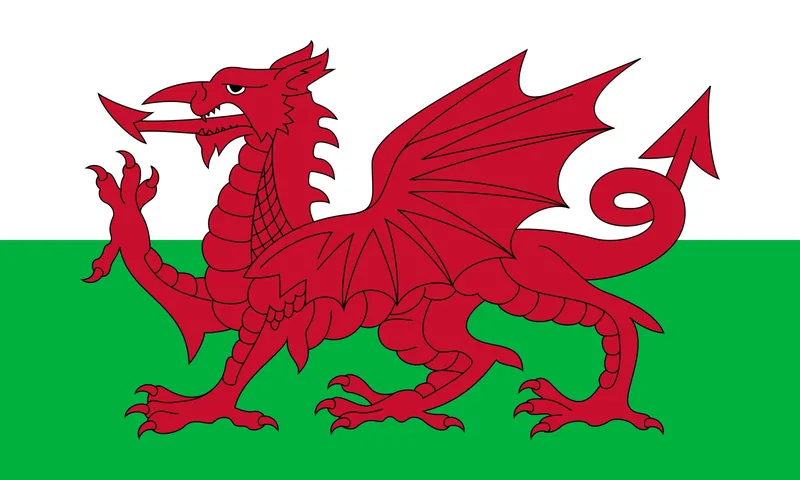
History Museum Wales says the dragon emblem was probably brought into Britain by the Roman legions. Amgueddfa Cymru – Museum Wales: National emblems (FAQ) ↗
History Visit Wales says the Romans used the dragon as a military standard and probably borrowed it from the Dacians. Visit Wales: The legend of the Welsh dragon ↗
Tradition According to tradition, says Museum Wales, the red dragon appeared on a crest borne by Arthur, whose father, Uthr Bendragon, had seen a dragon in the sky foretelling that he would be king. Amgueddfa Cymru – Museum Wales: National emblems (FAQ) ↗
History Medieval Welsh poets often compared their leaders to dragons. The poet Gruffydd ab yr Ynad Coch said of Llywelyn ap Gruffudd: ‘pen draig oedd arnaw’, ‘a dragon’s head he had’. Amgueddfa Cymru – Museum Wales: National emblems (FAQ) ↗
Glyndŵr and the Tudors
History When Owain Glyndŵr rose against Henry IV in 1400, he fought under a white banner with a golden dragon. Visit Wales: The legend of the Welsh dragon ↗
History Henry Tudor put a red dragon on a white and green background, the Tudor colours, and presented it at St Paul’s Cathedral after his victory at Bosworth in 1485. Visit Wales: The legend of the Welsh dragon ↗
History From 1485 to 1603 the dragon was part of the arms of the Tudor kings and queens. James I replaced it on the royal coat of arms with a unicorn. Amgueddfa Cymru – Museum Wales: National emblems (FAQ) ↗
History The red dragon held up the royal arms of the Tudor kings Henry VII, Henry VIII and Edward VI. Elizabeth I changed its colour to gold. A. C. Fox-Davies, A Complete Guide to Heraldry, Project Gutenberg ↗
History The red dragon badge of Wales is called the red dragon of Cadwallader. A. C. Fox-Davies, A Complete Guide to Heraldry, Project Gutenberg ↗
History One of the royal heralds is the Rouge Dragon pursuivant, named after the red dragon that supported the arms of Henry VII, who created the post. A. C. Fox-Davies, A Complete Guide to Heraldry, Project Gutenberg ↗
From royal badge to national flag
History The dragon was not included in the Union Flag of 1606. Visit Wales: The legend of the Welsh dragon ↗
History The red dragon came back as the royal badge for Wales in 1807, and Welsh patriotic societies often used it after that. Amgueddfa Cymru – Museum Wales: National emblems (FAQ) ↗
History In March 1953 the Queen approved that the Red Dragon Badge, a Royal Badge for Wales for over 150 years, should be ‘honourably augmented’ (given an addition). Hansard, House of Commons written answers, 23 February 1959: Welsh Flag ↗
History On 23 February 1959 the Minister for Welsh Affairs, Henry Brooke, told the House of Commons that only the Red Dragon on a green and white flag would in future be flown on Government buildings in Wales. Hansard, House of Commons written answers, 23 February 1959: Welsh Flag ↗
History Museum Wales says it was at the suggestion of the Gorsedd of the Bards that the Queen officially recognised the flag in 1959. Amgueddfa Cymru – Museum Wales: National emblems (FAQ) ↗
History Britannica notes that in the 20th century the dragon was officially added to the coat of arms of the prince of Wales. Britannica (Scholars): dragon ↗
How heralds draw dragons
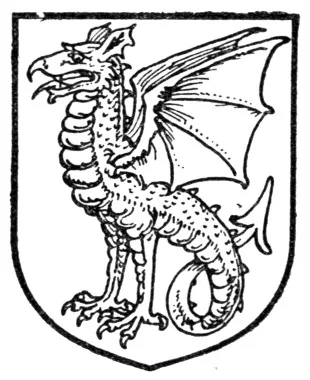
History In heraldry, the dragon’s wings are always bat’s wings. A. C. Fox-Davies, A Complete Guide to Heraldry, Project Gutenberg ↗
History Modern heraldic dragons usually have a barbed tail, but Fox-Davies says this is ‘a comparatively recent addition’: Tudor dragons had long, smooth tails ending in a blunt point. A. C. Fox-Davies, A Complete Guide to Heraldry, Project Gutenberg ↗
History In German heraldry the four-footed dragon is called the Lindwurm. A. C. Fox-Davies, A Complete Guide to Heraldry, Project Gutenberg ↗
History The wyvern has only two legs; its body curls away into its tail. A. C. Fox-Davies, A Complete Guide to Heraldry, Project Gutenberg ↗
History The cockatrice is like a wyvern but with the head of a cock. A. C. Fox-Davies, A Complete Guide to Heraldry, Project Gutenberg ↗
Tradition Old writers claimed a basilisk hatched from an egg laid by a nine-year-old cock and hatched by a toad. A. C. Fox-Davies, A Complete Guide to Heraldry, Project Gutenberg ↗
Follow the thread
Amgueddfa Cymru – Museum Wales: National emblems (FAQ) ↗
Visit Wales: The legend of the Welsh dragon ↗
A. C. Fox-Davies, A Complete Guide to Heraldry, Project Gutenberg ↗
Hansard, House of Commons written answers, 23 February 1959: Welsh Flag ↗
Britannica (Scholars): dragon ↗
Retellings are in our own words. Every sentence above carries a label (History, Literature or Tradition) and a link to the source it was checked against. A legend is not a historical record.
Source method & more reading ↗