Checked against Manx National Heritage and the Isle of Man Guide · Isle of Man · Published 31 October 2026
Four Sigurd crosses
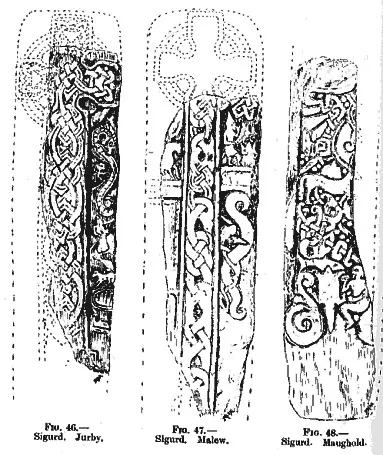
History The Andreas cross is one of four Sigurd crosses found on the Isle of Man; the others are at Jurby, Malew and Maughold. Isle of Man Guide: Sigurd’s Cross (no. 121), Kirk Andreas ↗
History Manx National Heritage and its partners made 3D images of all 210 Manx crosses for its iMuseum. Manx National Heritage: Learning about the Manx Crosses ↗
Sigurd’s Cross, Kirk Andreas (no. 121)
History Sigurd’s Cross at Kirk Andreas (no. 121) is believed to date from the late tenth century. Isle of Man Guide: Sigurd’s Cross (no. 121), Kirk Andreas ↗
History One side shows Sigurd piercing the dragon with his sword, then roasting its heart and cooling his scalded fingers in his mouth, with his horse Grani above. Isle of Man Guide: Sigurd’s Cross (no. 121), Kirk Andreas ↗
History The other side shows a later part of the story: Gunnar, who had gained the treasure, thrown into the snake pit. Isle of Man Guide: Sigurd’s Cross (no. 121), Kirk Andreas ↗
Jurby
History The scene of Sigurd in the pit driving his sword into the dragon is shown most clearly on a cross at Jurby. Isle of Man Guide: Sigurd’s Cross (no. 121), Kirk Andreas ↗
History On the Manx crosses, Fafnir is carved as ‘a writhing interlacing creature’. Manx National Heritage: Learning about the Manx Crosses ↗
The Maughold slab (no. 122)
History The Maughold slab (no. 122) came from a wall in a Ramsey house and dates from about 1150. Isle of Man Guide: Sigurd Slab (no. 122), Kirk Maughold ↗
History One scene on it shows Grani carrying the gold hoard won by slaying the dragon. Isle of Man Guide: Sigurd Slab (no. 122), Kirk Maughold ↗
History The Sigurd story on the Maughold cross (number 122) shows the god Loki killing Otr, a shape-shifter and Fafnir’s brother, with a stone. Manx National Heritage: Learning about the Manx Crosses ↗
The Dragon Cross, Kirk Michael (no. 117)
History The Dragon Cross at Kirk Michael (no. 117) has a dragon, long arrow-headed tails and pear-shaped eyes that the Isle of Man Guide calls Norse in style. Isle of Man Guide: Dragon Cross (no. 117), Kirk Michael ↗
Who told Sigurd to dig?
Literature Regin told Sigurd to dig a pit on Fafnir’s path. An old man with a long beard told him to dig many pits, so the blood could run away. The Story of the Volsungs, trans. William Morris and Eiríkr Magnússon (1888), Project Gutenberg ↗
History The Isle of Man Guide tells the story with Odin telling Sigurd to dig a pit and wait for the dragon. Isle of Man Guide: Sigurd’s Cross (no. 121), Kirk Andreas ↗
The saga as translated by Morris and Magnússon calls the adviser an old man with a long beard. The Isle of Man Guide names him as Odin. We give both.
Is there a Manx dragon tale?
We looked for a Manx folk tale about a dragon and did not find one in the sources we checked. The island’s dragon lore that we can source is carved in stone: the Norse story of Sigurd and Fafnir, and the Dragon Cross at Kirk Michael.
Follow the thread
Isle of Man Guide: Sigurd’s Cross (no. 121), Kirk Andreas ↗
Manx National Heritage: Learning about the Manx Crosses ↗
Isle of Man Guide: Sigurd Slab (no. 122), Kirk Maughold ↗
Isle of Man Guide: Dragon Cross (no. 117), Kirk Michael ↗
The Story of the Volsungs, trans. William Morris and Eiríkr Magnússon (1888), Project Gutenberg ↗
Retellings are in our own words. Every sentence above carries a label (History, Literature or Tradition) and a link to the source it was checked against. A legend is not a historical record.
Source method & more reading ↗