Retold in our own words from the Story of the Volsungs, translated by William Morris and Eiríkr Magnússon (1888) · Published 31 October 2026
The otter’s price
Literature Regin told young Sigurd that his father Hreidmar had three sons: Fafnir, Otter and Regin himself. The Story of the Volsungs, trans. William Morris and Eiríkr Magnússon (1888), Project Gutenberg ↗
Literature The god Loki killed Otter with a stone. To pay for it, the gods had to fill the otter skin with gold and cover it over with red gold. The Story of the Volsungs, trans. William Morris and Eiríkr Magnússon (1888), Project Gutenberg ↗
Literature The gold came from the dwarf Andvari. He cried out that his ring, and all the gold with it, would be the bane of every man who owned it. The Story of the Volsungs, trans. William Morris and Eiríkr Magnússon (1888), Project Gutenberg ↗
Literature Fafnir killed his father for the treasure and became ‘the worst of all worms’, lying on the gold. The Story of the Volsungs, trans. William Morris and Eiríkr Magnússon (1888), Project Gutenberg ↗
The pit
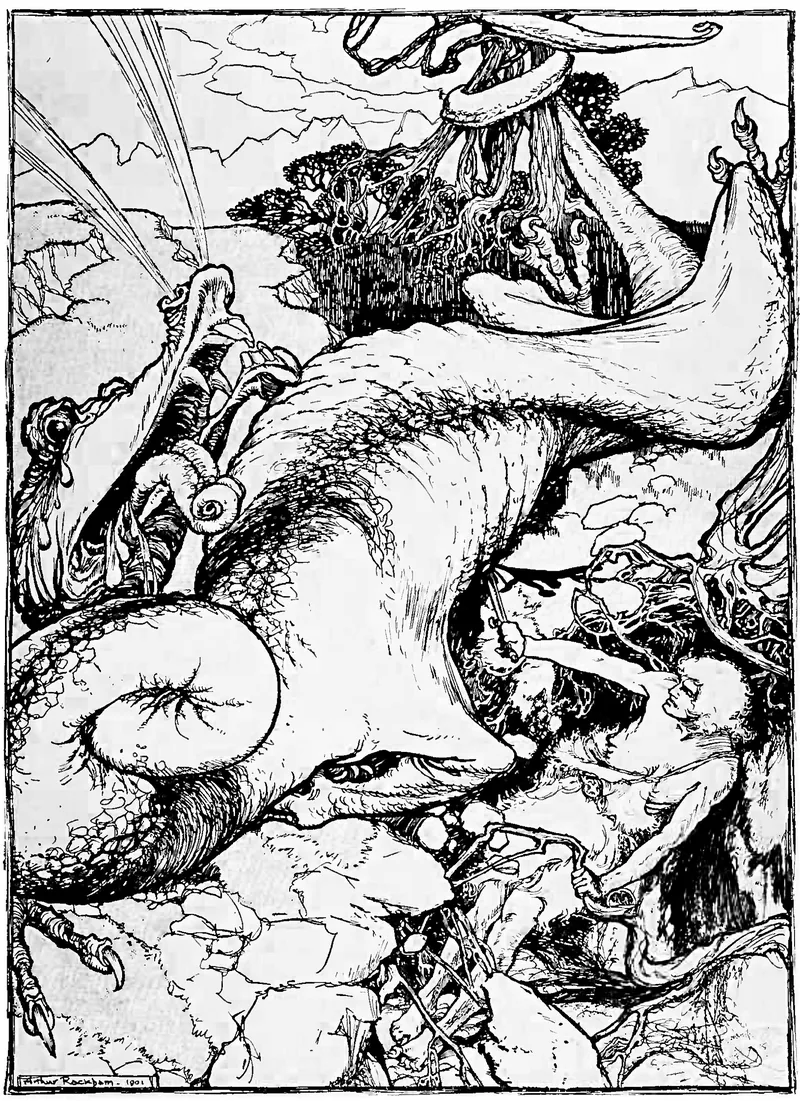
Literature Regin told Sigurd to dig a pit on Fafnir’s path. An old man with a long beard told him to dig many pits, so the blood could run away. The Story of the Volsungs, trans. William Morris and Eiríkr Magnússon (1888), Project Gutenberg ↗
Literature When Fafnir crawled over to drink, Sigurd thrust his sword up under its left shoulder. The Story of the Volsungs, trans. William Morris and Eiríkr Magnússon (1888), Project Gutenberg ↗
Literature Fafnir warned him that the same gold would be his bane too. The Story of the Volsungs, trans. William Morris and Eiríkr Magnússon (1888), Project Gutenberg ↗
The heart and the birds
Literature Roasting the dragon’s heart on a rod, Sigurd burned his finger and put it in his mouth. At once he understood the voices of the birds. The Story of the Volsungs, trans. William Morris and Eiríkr Magnússon (1888), Project Gutenberg ↗
Literature When Sigurd understood birds, the first he heard were wood-peckers chattering in the brushwood. The Story of the Volsungs, trans. William Morris and Eiríkr Magnússon (1888), Project Gutenberg ↗
Literature Regin cut out Fafnir’s heart with a sword called Ridil. The Story of the Volsungs, trans. William Morris and Eiríkr Magnússon (1888), Project Gutenberg ↗
About the saga
Literature The Story of the Volsungs used here is the 1888 translation by William Morris and Eiríkr Magnússon. The Story of the Volsungs, trans. William Morris and Eiríkr Magnússon (1888), Project Gutenberg ↗
Literature Sigurd’s sword was called Gram, and his horse Grani. The Story of the Volsungs, trans. William Morris and Eiríkr Magnússon (1888), Project Gutenberg ↗
Carved in stone on the Isle of Man
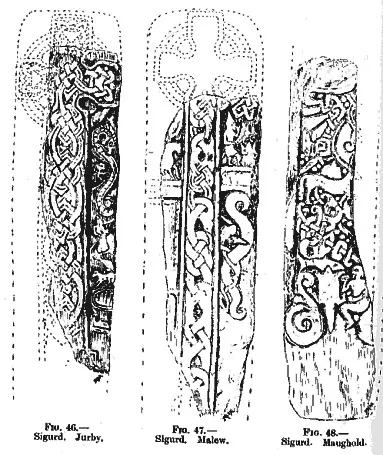
History The Andreas cross is one of four Sigurd crosses found on the Isle of Man; the others are at Jurby, Malew and Maughold. Isle of Man Guide: Sigurd’s Cross (no. 121), Kirk Andreas ↗
History The scene of Sigurd in the pit driving his sword into the dragon is shown most clearly on a cross at Jurby. Isle of Man Guide: Sigurd’s Cross (no. 121), Kirk Andreas ↗
History On the Manx crosses, Fafnir is carved as ‘a writhing interlacing creature’. Manx National Heritage: Learning about the Manx Crosses ↗
The Manx crosses are the clearest link between the Isle of Man and dragon lore. Read the Isle of Man guide for each cross.
Follow the thread
The Story of the Volsungs, trans. William Morris and Eiríkr Magnússon (1888), Project Gutenberg ↗
Isle of Man Guide: Sigurd’s Cross (no. 121), Kirk Andreas ↗
Manx National Heritage: Learning about the Manx Crosses ↗
Retellings are in our own words. Every sentence above carries a label (History, Literature or Tradition) and a link to the source it was checked against. A legend is not a historical record.
Source method & more reading ↗