Retold in our own words from William Caxton’s English version of the Golden Legend; history from English Heritage, the Church of England and Britannica · Published 31 October 2026
The story
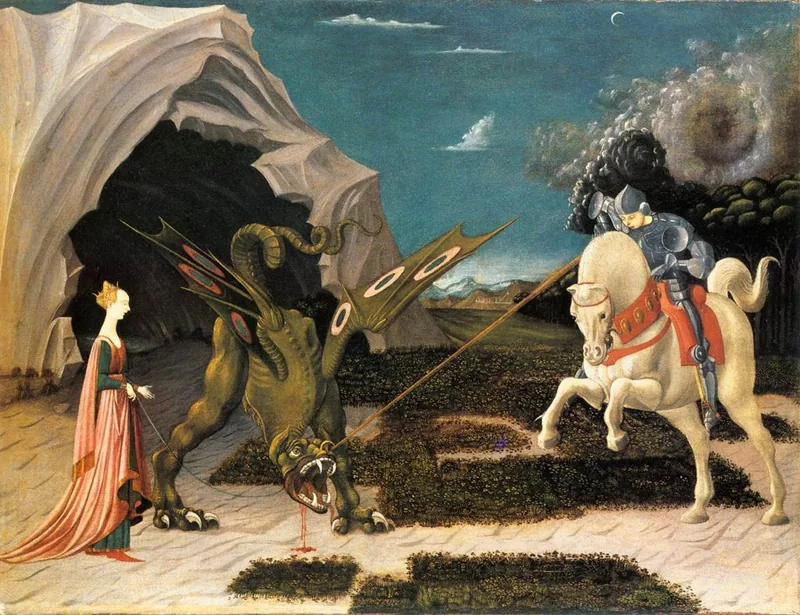
Literature In the Golden Legend, George is a knight born in Cappadocia. He comes to Silene in Libya, where a dragon lives in a pond as big as a sea and poisons the land with its breath. Jacobus de Voragine, The Golden Legend, vol. 3, in William Caxton’s English (first printed 1483), Fordham University Medieval Sourcebook ↗
Literature To keep it away, the people gave it two sheep a day. When the sheep ran short, they chose by lot who would be sent instead. Jacobus de Voragine, The Golden Legend, vol. 3, in William Caxton’s English (first printed 1483), Fordham University Medieval Sourcebook ↗
Literature The lot fell on the king’s own daughter. He begged the people to take his gold and silver instead, but they refused, and she was given eight days’ respite. Jacobus de Voragine, The Golden Legend, vol. 3, in William Caxton’s English (first printed 1483), Fordham University Medieval Sourcebook ↗
Literature George rode by, heard her story and stayed. When the dragon came, he made the sign of the cross, charged and wounded it with his spear. Jacobus de Voragine, The Golden Legend, vol. 3, in William Caxton’s English (first printed 1483), Fordham University Medieval Sourcebook ↗
Literature He told the princess to tie her girdle round the dragon’s neck. She led it into the city, and it followed her ‘as it had been a meek beast’. Jacobus de Voragine, The Golden Legend, vol. 3, in William Caxton’s English (first printed 1483), Fordham University Medieval Sourcebook ↗
Literature The king and his people were baptised, fifteen thousand men not counting women and children. George slew the dragon, and four ox carts dragged it out of the city. Jacobus de Voragine, The Golden Legend, vol. 3, in William Caxton’s English (first printed 1483), Fordham University Medieval Sourcebook ↗
Literature The king offered George a great treasure. He refused it all and asked for it to be given to the poor. Jacobus de Voragine, The Golden Legend, vol. 3, in William Caxton’s English (first printed 1483), Fordham University Medieval Sourcebook ↗
Who wrote it down
Literature The Golden Legend was compiled by Jacobus de Voragine, Archbishop of Genoa. William Caxton’s English version was first printed in 1483. Jacobus de Voragine, The Golden Legend, vol. 3, in William Caxton’s English (first printed 1483), Fordham University Medieval Sourcebook ↗
History English Heritage says the story was developed and made popular in the Middle Ages by The Golden Legend, a book of saints’ lives. English Heritage: 9 things you didn’t know about St George ↗
History Britannica says legends from the early Middle Ages show George rescuing a Libyan king’s daughter from a dragon. Britannica (Students): dragon ↗
The real George
History English Heritage says the real George was most likely a Greek-speaker who lived in the Roman Near East and died a martyr in about AD 303. English Heritage: 9 things you didn’t know about St George ↗
History His tomb at Diospolis, or Lydda (now Lod in Israel), soon drew pilgrims. English Heritage: 9 things you didn’t know about St George ↗
History He was probably an officer in the Roman army rather than a knight in armour. English Heritage: 9 things you didn’t know about St George ↗
History He died for his faith in the early 300s, during the persecution begun by the Emperor Diocletian. English Heritage: 9 things you didn’t know about St George ↗
History The earliest evidence that he existed is a mid-4th-century inscription from Syria. English Heritage: 9 things you didn’t know about St George ↗
When did the dragon arrive?
History The dragon story post-dates the real George by several centuries. Pictures of George and the dragon survive from the 9th century, about 500 years after his death. English Heritage: 9 things you didn’t know about St George ↗
History The Church of England says the legend of George slaying a dragon (or sea-monster) only appeared in the 1200s. Church of England: Celebrating St George, martyr and patron saint of England ↗
These two sources disagree. English Heritage says pictures of George and the dragon survive from the 9th century; the Church of England says the legend only appeared in the 1200s. Both agree that the dragon arrived centuries after the real George.
Dragon Hill, Uffington
Tradition At Uffington the bare white patch on top of Dragon Hill is said to be where the dragon fell dead, its blood so poisonous that grass has never grown there. National Trust: History at White Horse Hill ↗
History Dragon Hill is about 10 metres high: a natural outcrop of the downs, shaped by melting ice in the Ice Age. National Trust: History at White Horse Hill ↗
History The National Trust points out that George was not English and, as far as history knows, never visited Uffington. National Trust: History at White Horse Hill ↗
Tradition Another suggestion, says the National Trust, is that Dragon Hill is the burial place of Uther Pendragon, a British chieftain who fought the Saxons. National Trust: History at White Horse Hill ↗
History English Heritage says local legend links the White Horse with St George and the Dragon, hence the name of nearby Dragon Hill. English Heritage: History of Uffington Castle, White Horse and Dragon Hill ↗
History The White Horse, Uffington Castle and Dragon Hill sit beside the Ridgeway, an ancient route across the chalk downs. English Heritage: History of Uffington Castle, White Horse and Dragon Hill ↗
Follow the thread
English Heritage: 9 things you didn’t know about St George ↗
Britannica (Students): dragon ↗
Church of England: Celebrating St George, martyr and patron saint of England ↗
National Trust: History at White Horse Hill ↗
English Heritage: History of Uffington Castle, White Horse and Dragon Hill ↗
Retellings are in our own words. Every sentence above carries a label (History, Literature or Tradition) and a link to the source it was checked against. A legend is not a historical record.
Source method & more reading ↗