Retold in our own words from William Henderson’s Notes on the Folk-Lore of the Northern Counties (1879), which uses Sharpe’s Bishoprick Garland · Published 31 October 2026
The story
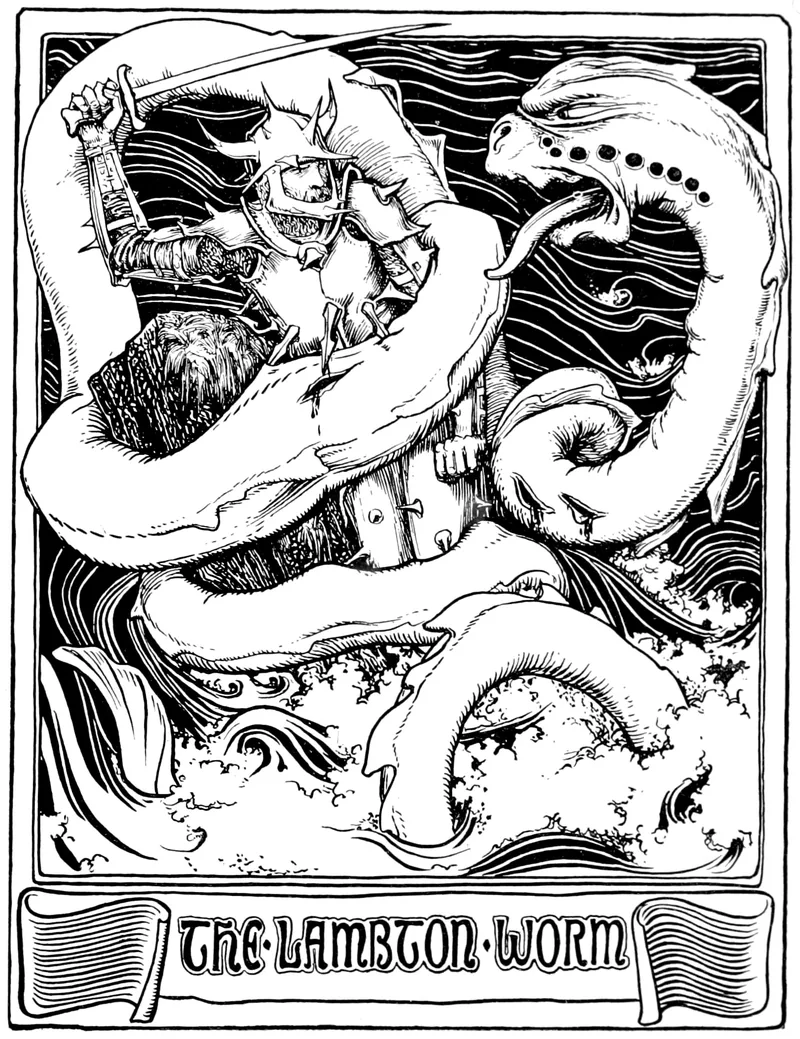
Literature Long ago, some say in the 1300s, the young heir of Lambton skipped mass on Sunday mornings to go fishing in the River Wear. William Henderson, Notes on the Folk-Lore of the Northern Counties of England and the Borders (1879), chapter 8, Wikisource ↗
Literature One Sunday he hooked an ugly worm and flung it into a well close by, still called the Worm Well. William Henderson, Notes on the Folk-Lore of the Northern Counties of England and the Borders (1879), chapter 8, Wikisource ↗
Literature A passing stranger said it looked like an eft (a newt), except that it had nine holes on each side of its mouth. William Henderson, Notes on the Folk-Lore of the Northern Counties of England and the Borders (1879), chapter 8, Wikisource ↗
Literature The worm outgrew the well. By day it lay coiled round a rock in the river; by night it twined round a hill, which it could soon circle three times. People still call it Worm Hill. William Henderson, Notes on the Folk-Lore of the Northern Counties of England and the Borders (1879), chapter 8, Wikisource ↗
Literature The heir had gone away to the wars, some say as a crusader, for seven long years. At home, the worm was kept calm with a trough filled with the milk of ‘nine kye’, nine cows. William Henderson, Notes on the Folk-Lore of the Northern Counties of England and the Borders (1879), chapter 8, Wikisource ↗
Literature Knights who fought it failed: it could join itself together again after being cut in two. William Henderson, Notes on the Folk-Lore of the Northern Counties of England and the Borders (1879), chapter 8, Wikisource ↗
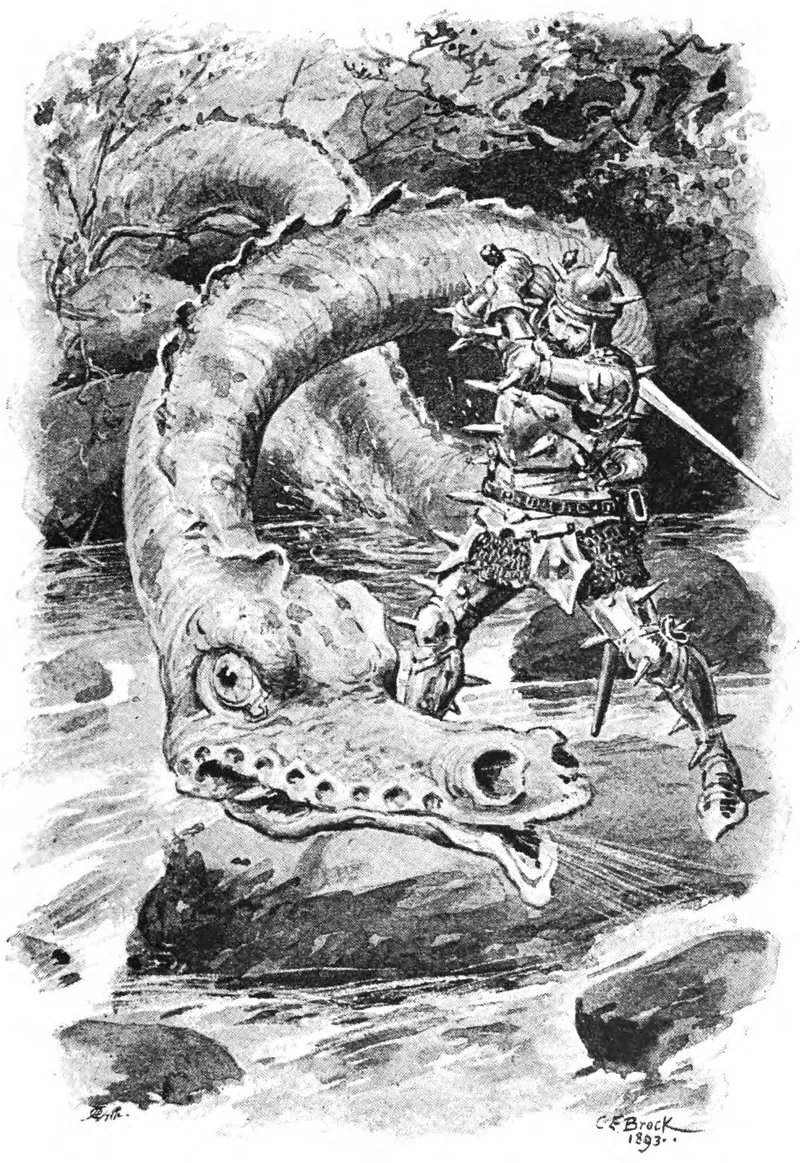
Literature The heir came home and asked a wise woman. She told him to stud his armour with spear-heads, stand on the rock in the river, and vow to kill the first living thing he met afterwards. William Henderson, Notes on the Folk-Lore of the Northern Counties of England and the Borders (1879), chapter 8, Wikisource ↗
Literature The worm wrapped itself round him and cut itself on the spikes. He cut it in two, and the fast river carried one half away, so it could never join up again. William Henderson, Notes on the Folk-Lore of the Northern Counties of England and the Borders (1879), chapter 8, Wikisource ↗
Literature He had promised to blow his bugle so the household would let loose his hound, the first thing he would meet. But his father forgot and rushed out himself. The knight could not lift his hand against his father; the hound was let loose and killed instead. It was too late: the vow was broken, and the curse lay on the Lambtons for nine generations. William Henderson, Notes on the Folk-Lore of the Northern Counties of England and the Borders (1879), chapter 8, Wikisource ↗
The curse and the family
Tradition The Lambton curse said that for nine generations no lord of Lambton would die in his bed. William Henderson, Notes on the Folk-Lore of the Northern Counties of England and the Borders (1879), chapter 8, Wikisource ↗
Literature An old Lambton family pedigree says: ‘John Lambton, that slewe ye worme, was knight of Rhodes.’ William Henderson, Notes on the Folk-Lore of the Northern Counties of England and the Borders (1879), chapter 8, Wikisource ↗
Worm Hill
History Worm Hill is oval, on the north side of the River Wear, about a mile and a half from old Lambton Hall. William Henderson, Notes on the Folk-Lore of the Northern Counties of England and the Borders (1879), chapter 8, Wikisource ↗
Tradition In the north of England, dragons were locally called ‘worms’, from the Norse word Ormr, a serpent or dragon. William Henderson, Notes on the Folk-Lore of the Northern Counties of England and the Borders (1879), chapter 8, Wikisource ↗
Where the story comes from
Literature Henderson’s Lambton story comes from Sir Cuthbert Sharpe’s Bishoprick Garland, of which only 150 copies were printed. William Henderson, Notes on the Folk-Lore of the Northern Counties of England and the Borders (1879), chapter 8, Wikisource ↗
Literature Joseph Jacobs included the Lambton Worm in More English Fairy Tales and said that he had rewritten most of the tales in that book. Joseph Jacobs (ed.), More English Fairy Tales, Project Gutenberg ↗
So the Lambton Worm reached most modern readers through two Victorian collectors. Jacobs tells us himself that he rewrote his versions.
Follow the thread
Joseph Jacobs (ed.), More English Fairy Tales, Project Gutenberg ↗
Retellings are in our own words. Every sentence above carries a label (History, Literature or Tradition) and a link to the source it was checked against. A legend is not a historical record.
Source method & more reading ↗