Retold in our own words from the History of the Britons attributed to Nennius (J. A. Giles’s translation); places from Visit Wales · Published 31 October 2026
The story
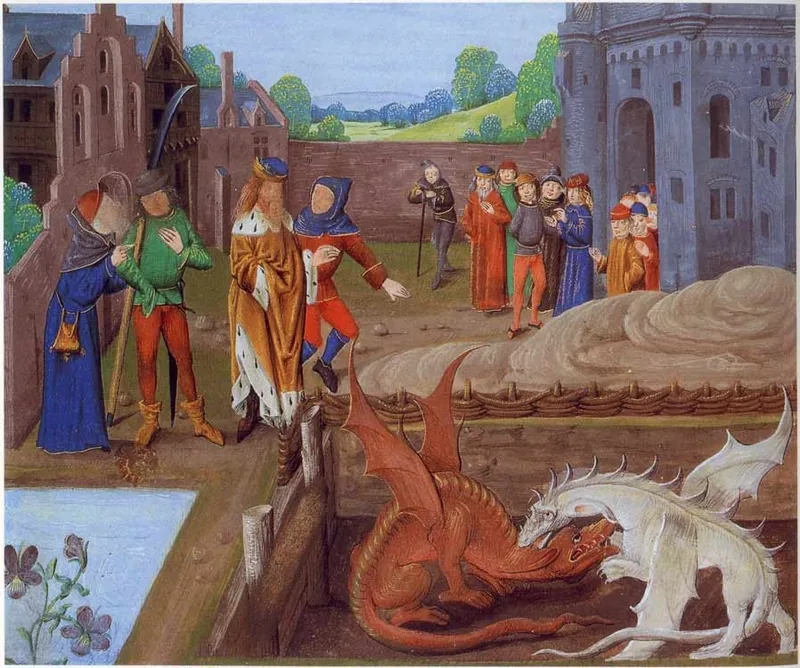
Literature King Vortigern wanted a strong fortress. His wise men searched the mountains and chose a hilltop for it. Nennius, History of the Britons, trans. J. A. Giles, Project Gutenberg ↗
Literature Builders gathered wood and stone, but in a single night all of it vanished. It happened three times. Nennius, History of the Britons, trans. J. A. Giles, Project Gutenberg ↗
Literature The wise men gave cruel advice: find a boy who had no father and kill him so his blood could be sprinkled on the ground. Messengers found such a boy and brought him to the king. Nennius, History of the Britons, trans. J. A. Giles, Project Gutenberg ↗
Literature The boy asked the wise men what lay under the ground. They could not say. He told the king to dig: below was a pool, in the pool two vases, and in the vases a tent. Nennius, History of the Britons, trans. J. A. Giles, Project Gutenberg ↗
Literature Inside the tent slept two serpents, one white and one red. They woke and fought. Three times the white one drove the red one back, but at last the red one grew strong and chased the white one out of the tent and across the pool. Nennius, History of the Britons, trans. J. A. Giles, Project Gutenberg ↗
Literature The boy explained: ‘the two serpents are two dragons; the red serpent is your dragon’. The white dragon stood for the Saxons, who would one day be driven back. Nennius, History of the Britons, trans. J. A. Giles, Project Gutenberg ↗
Literature The boy said his name was Ambrose and that his father was a Roman consul. The king gave him the hilltop and went off to build elsewhere. Nennius, History of the Britons, trans. J. A. Giles, Project Gutenberg ↗
Where it happened
Literature In Giles’s notes, the hill where Vortigern tried to build is ‘supposed to be Dinas Emrys, or the fortress of Ambrosius’, in the mountains of Snowdon. Nennius, History of the Britons, trans. J. A. Giles, Project Gutenberg ↗
History Visit Wales reports that an excavation of Dinas Emrys in 1945 showed evidence of a lake and a fortress dating back to Vortigern’s time. Visit Wales: The legend of the Welsh dragon ↗
An excavation can show that people lived on a hill. It cannot show that dragons slept under it. The red dragon of Wales has older roots as a Roman standard, and the history guide follows them.
Who told it
Literature Project Gutenberg’s edition of the History of the Britons lists its author Nennius as ‘active 796’. The English translation is by J. A. Giles. Nennius, History of the Britons, trans. J. A. Giles, Project Gutenberg ↗
Literature Visit Wales notes that Geoffrey of Monmouth also told the story in his 12th-century History of the Kings of Britain, where the boy is believed to be Merlin. Visit Wales: The legend of the Welsh dragon ↗
Follow the thread
Nennius, History of the Britons, trans. J. A. Giles, Project Gutenberg ↗
Visit Wales: The legend of the Welsh dragon ↗
Retellings are in our own words. Every sentence above carries a label (History, Literature or Tradition) and a link to the source it was checked against. A legend is not a historical record.
Source method & more reading ↗